
Introduction: The Moment It All Makes Sense
Sofia had been living in Dubai for three years, paying AED 95,000 a year in rent for a two-bedroom apartment in Al Barsha. She loved the city — the weather, the safety, the career opportunities — but every time her lease came up for renewal, she felt the same creeping anxiety. Would the landlord raise the rent again? Would she have to move?
In late 2024, a colleague mentioned offhandedly that his mortgage payment on a similar apartment in Jumeirah Village Circle was AED 6,200 a month. Sofia had been paying nearly AED 8,000. That conversation changed everything.
She reached out, asked questions, got guidance, and four months later she was a property owner in Dubai. Her monthly costs dropped. Her net worth grew. And the city she loved became a place she truly owned a piece of.
If you’re considering whether to buy property in Dubai, Sofia’s story is one of thousands playing out across this city every year. Dubai in 2026 is not just a destination — it’s a long-term home for millions of residents from over 200 nationalities, and an investment destination that continues to outperform nearly every comparable global market.
This guide gives you everything you need: the best areas, the real numbers, the process, and the insight to make your move with confidence.
Why 2026 Is a Pivotal Year to Buy Property in Dubai
The Dubai property market has gone through cycles like every global market — but the fundamentals underpinning 2026 demand are structurally different from anything the city has seen before.
Transaction volumes hit record territory in 2025, with the Dubai Land Department recording over AED 900 billion in total real estate transactions — a figure that reflects not just speculative activity, but genuine end-user demand from people choosing Dubai as a permanent base.
The reasons behind this sustained momentum are worth understanding if you’re a serious buyer.
The UAE’s Golden Visa program has fundamentally changed who buys in Dubai and why. Purchasing property worth AED 2,000,000 or more now entitles international buyers to a 10-year UAE residency visa. For families, entrepreneurs, and professionals seeking stability and a tax-free environment, this is a life-changing policy that has unlocked buyer pools from Europe, India, Africa, and beyond.
Population growth continues to put structural pressure on housing supply. Dubai’s population crossed 3.8 million in 2025 and is projected to exceed 5 million by 2030. More people means more demand — and more demand means prices in high-quality communities continue to move upward.
Rental yields remain globally exceptional. While London delivers 3–4% and Singapore hovers around 2–3%, Dubai consistently produces gross rental yields of 5–8%, with emerging areas pushing toward 9%. For investors, these numbers change the conversation entirely.
And unlike many global cities, Dubai levies zero annual property tax. What you earn from your property, you keep.
The Best Areas to Buy Property in Dubai in 2026
Location shapes everything — your lifestyle, your yield, your appreciation potential, and your resale options. Dubai offers an extraordinary range of communities, each suited to different buyer profiles. Here’s where smart buyers are looking right now.
Jumeirah Village Circle (JVC) — Best Value for Families and Investors
JVC has become the most searched community for buyers looking to purchase property in Dubai at a compelling price-to-quality ratio. The neighborhood offers a genuine community feel — over 30 parks, international schools, supermarkets, gyms, and cafes — within a well-designed master plan that prioritizes livability.
Prices range from AED 1,100 to 1,400 per sqft, making quality two and three-bedroom apartments accessible to a wide range of buyers. Rental yields sit at 6–8%, and the tenant pool is deep and consistent given the community’s popularity with working professionals and families.
JVC amenities punch well above their price point, and for buyers entering the Dubai market for the first time, it represents a combination of affordability, community quality, and investment sense that is genuinely hard to beat.
Dubai Hills Estate — Premium Family Living With Strong Appreciation
Dubai Hills Estate has matured into one of Dubai’s most desirable family communities, and off-plan properties in Dubai Hills Estate continue to attract strong buyer interest even as the area’s secondary market prices have risen significantly.
The community wraps around an 18-hole championship golf course, anchored by Dubai Hills Mall and surrounded by top-tier schools, hospitals, cycling tracks, and beautifully landscaped parks. It feels — and operates — like a self-contained suburban town within a global city.
Prices range from AED 1,500 to 2,800 per sqft depending on property type, with villas commanding the higher end. Buyers here tend to be longer-horizon investors and families prioritizing school access and green space over yield maximization.
Dubai South — The Growth Story That’s Still Unfolding
If you want to be ahead of the market rather than chasing it, Dubai South is the area that demands your attention. The ongoing development of Al Maktoum International Airport — set to become the world’s largest aviation hub — is anchoring an entirely new urban district around it, and the ripple effects on local property values are already evident.
Properties here range from AED 700 to 1,100 per sqft, and rental yields of 7–9% reflect genuine tenant demand from airport workers, logistics professionals, and value-conscious families who want quality housing without Marina prices.
Buyers who entered Dubai South two years ago have seen capital appreciation of 20–30% in some sub-communities. The infrastructure investment underwriting this growth is government-backed and multi-decade in scale — this isn’t speculative froth.
Arjan — Quiet Growth, Steady Returns
Positioned between Al Barsha and Dubailand, Arjan is the under-the-radar pick for mid-term investors who want solid fundamentals without the crowd. Strong connectivity to Sheikh Zayed Road, a growing dining and retail scene, and consistent infrastructure development are pushing values steadily upward.
Entry prices of AED 900–1,200 per sqft and rental yields of 6–8% make it compelling for buyers who want Dubai South-level returns with slightly better existing community infrastructure.
Palm Jumeirah — Prestige, Lifestyle, Legacy
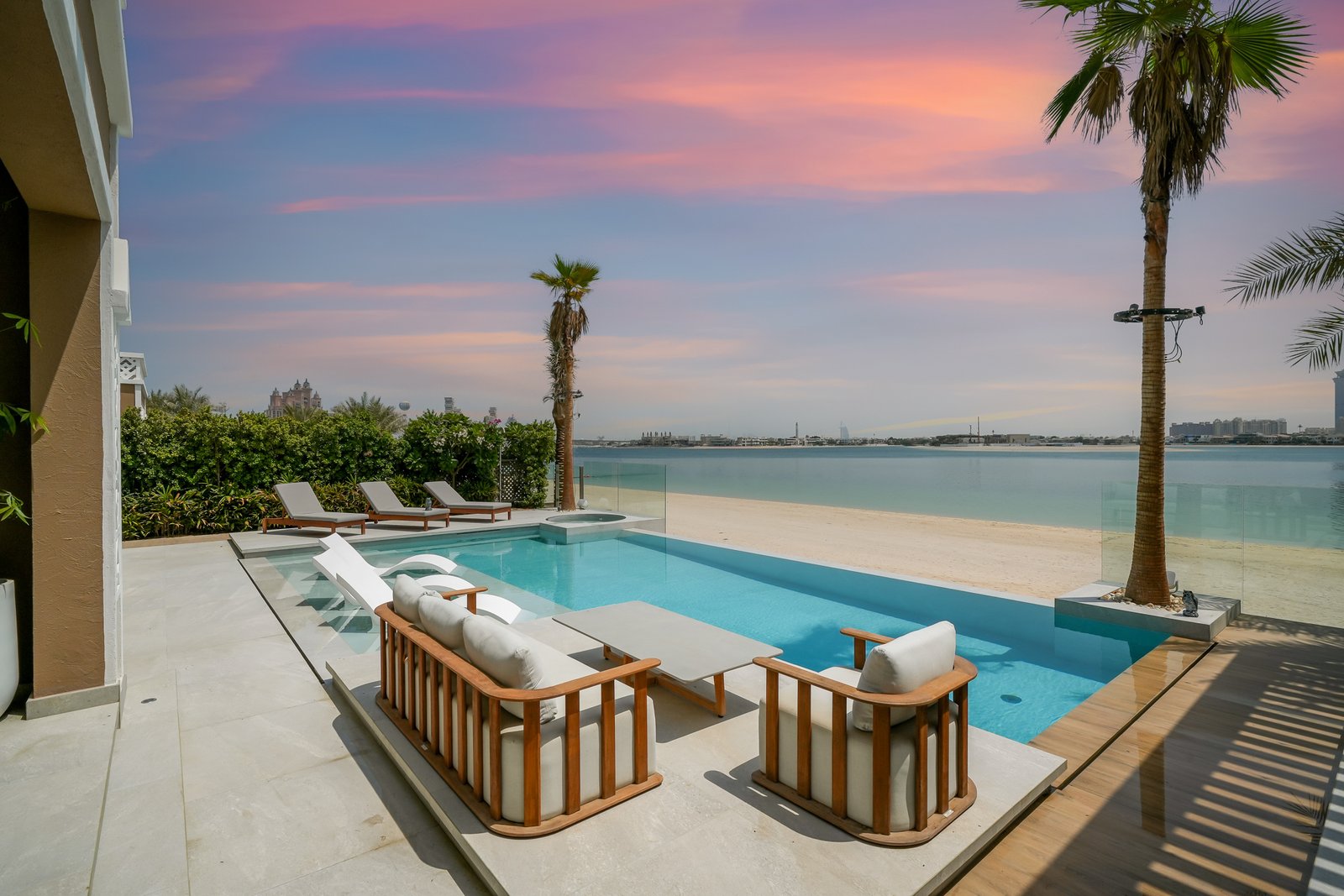
For buyers for whom the financial calculation is secondary to the experience of ownership, Palm Jumeirah remains the ultimate Dubai address. Beachfront villas with private pools, panoramic Gulf views, and proximity to world-class hospitality make it a category of its own.
Prices range from AED 3,000 to over AED 5,500 per sqft, with premium branded residences exceeding this range considerably. Yields run 4–6%, but capital appreciation in ultra-prime units has been exceptional over any medium-to-long horizon.
| Neighborhood | Price (AED/sqft) | Rental Yield | Ideal Buyer |
|---|---|---|---|
| JVC | 1,100–1,400 | 6–8% | Families, first-time buyers |
| Dubai Hills Estate | 1,500–2,800 | 4–6% | Premium family buyers |
| Dubai South | 700–1,100 | 7–9% | Growth investors |
| Arjan | 900–1,200 | 6–8% | Mid-term investors |
| Business Bay | 1,400–2,000 | 5–7% | Urban professionals |
| Palm Jumeirah | 3,000–5,500+ | 4–6% | Ultra-premium buyers |
Source: Emirion market research & Dubai Land Department data, 2026
Off-Plan Properties in Dubai Hills Estate and Beyond: Is Buying Early Still Smart?
The off-plan market in Dubai is one of the most discussed — and most misunderstood — segments for international buyers. Here’s the clear-eyed version.
Off-plan properties are purchased directly from a developer before or during construction. The key advantages are pricing — typically 15–25% below comparable completed units — and payment flexibility. Most developers offer structured payment plans, often 60/40 or 70/30 splits between construction phase and handover, which dramatically reduces the upfront capital requirement compared to buying on the secondary market.
Off-plan properties in Dubai Hills Estate have been particularly sought after because the community’s strong brand, school access, and lifestyle amenities give buyers confidence that demand at handover will remain robust. The same logic applies to well-selected projects in emerging areas like Dubai South and Arjan, where infrastructure improvements are confirmed and underway.
The risk in off-plan is real — construction timelines shift, developers face financial challenges, and market conditions evolve. Dubai’s RERA regulations significantly mitigate these risks by requiring developers to maintain escrow accounts for buyer deposits, releasing funds only in line with verified construction milestones. Always verify RERA registration through the Dubai Land Department’s official portal before committing.
For buyers who do their due diligence — checking developer track records, confirming escrow arrangements, and choosing projects in areas with demonstrable demand drivers — off-plan remains one of the highest-potential strategies available in the Dubai market in 2026.
Explore our current off-plan and ready property listings at emirionllc.com/properties-2/.
2026 Trends Every Buyer Needs to Know
The Dubai property market in 2026 is being shaped by several powerful trends that go beyond simple supply and demand. Understanding these gives you an edge as a buyer.
Smart home technology is now a baseline expectation in new developments, not a premium feature. AI-driven climate systems, automated security, remote property management, and energy monitoring dashboards are being incorporated as standard in most 2026 launches. Properties without these features face increasing obsolescence risk on resale.
Sustainable communities are commanding premiums and growing demand. LEED-certified buildings, solar integration, greywater recycling systems, and car-light community design are attracting environmentally conscious buyers — a demographic growing rapidly among Dubai’s international resident base. Communities like The Sustainable City have demonstrated that green living and strong investment returns are not mutually exclusive.
The short-term rental market continues to expand with Dubai’s tourism boom. The emirate welcomed over 17 million international visitors in 2024, and that figure continues to climb. Furnished apartments in Marina, Downtown, and JBR are generating exceptional short-term rental yields for owners with holiday home licenses — which are relatively simple to obtain and manage.
Economic resilience is an underrated factor. While global markets navigate interest rate uncertainty and geopolitical volatility, Dubai’s diversified economy, fiscal stability, and government-led infrastructure investment create a property market insulated from many external shocks that affect comparable cities.
According to Dubai Pulse, infrastructure investment in connectivity, healthcare, and education continues at a pace that directly underpins residential property values across all price segments.
How to Buy Property in Dubai: Your Step-by-Step Process
The mechanics of purchasing property in Dubai are more straightforward than most international buyers expect. Here’s exactly how it works.
Step 1 — Define your goals clearly. Are you buying to live in the property, rent it out long-term, capitalize on short-term rental demand, or hold for capital appreciation? Your goal determines your ideal area, property type, and budget allocation. This step is more important than most buyers give it credit for.
Step 2 — Establish your budget including all costs. Beyond the purchase price, budget 6–8% for acquisition costs: the 4% Dubai Land Department transfer fee, a 2% agency fee, and approximately AED 4,000–5,000 in registration and admin costs. If you’re using a mortgage, factor in arrangement fees and insurance.
Step 3 — Engage a RERA-licensed broker. This protects you. Licensed brokers are legally accountable for the advice they give and the transactions they facilitate. Our team at Emirion LLC operates under full RERA licensing and can be verified through the official broker registry.
Step 4 — Shortlist and view properties. For ready properties, inspect in person or via comprehensive video tour. For off-plan, review the developer’s completed project portfolio, current RERA registration, escrow documentation, and payment plan terms.
Step 5 — Sign the Memorandum of Understanding (MOU). Once you’ve identified your property, the MOU formalizes the agreement between buyer and seller, locking in price and terms. A standard 10% deposit is paid at this stage.
Step 6 — Complete transfer at the Dubai Land Department. The final transfer is registered with the DLD, the 4% transfer fee is paid, and your title deed is issued. You are now a Dubai property owner.
Step 7 — Apply for Golden Visa if eligible. If you’ve purchased AED 2M+ of property, the Golden Visa application follows directly. Our team guides clients through the full residency process. Visit dubai.ae/property-housing for official framework guidance.
For a personalised walkthrough of this process based on your specific situation, contact our team for a no-obligation consultation.
Pros and Cons of Buying Property in Dubai in 2026
Before you commit, it’s worth seeing the full picture honestly.
The advantages are substantial. There is no annual property tax, no capital gains tax, and no income tax on rental earnings — making the total cost of ownership dramatically lower than comparable cities. Rental yields of 5–8% outperform nearly every established global market. The Golden Visa program provides long-term residency security for buyers meeting the AED 2M threshold. The regulatory framework is mature, transparent, and buyer-protective. And the lifestyle — safety, infrastructure, connectivity, climate — genuinely competes with the world’s best cities.
The considerations worth weighing: Dubai’s market has historically been cyclical, and while 2026 fundamentals are strong, no market offers guaranteed upside. Service charges vary significantly between communities and should always be factored into your yield calculations. Off-plan carries execution risk that ready properties don’t. And for buyers from non-USD or non-AED denominated economies, currency fluctuation adds a layer of complexity to return calculations.
The honest assessment: for the vast majority of international buyers with a 3–7 year horizon and realistic return expectations, buying property in Dubai in 2026 represents a compelling opportunity that is genuinely difficult to replicate in most other global markets.
Frequently Asked Questions About How to Buy Property in Dubai
1. Do I need to be a UAE resident to buy property in Dubai?
No. Non-residents from any country can purchase freehold property in Dubai’s designated freehold zones. There is no residency requirement — you can buy as a non-resident and the purchase itself can create a pathway to residency through the Golden Visa.
2. What is the cheapest area to buy property in Dubai?
Dubai South and Arjan currently offer the most accessible entry prices for buyers, with quality apartments available from approximately AED 450,000–650,000. Town Square and International City also offer budget-friendly options with reasonable community infrastructure.
3. Can I get a mortgage in Dubai as a foreigner?
Yes. UAE banks offer mortgages to non-resident expatriates, typically up to 75% LTV for properties valued below AED 5M. You’ll need proof of income, bank statements, and standard identification documentation. Our team can connect you with trusted mortgage advisors who specialize in international buyer financing.
4. How much is the transfer fee when I buy property in Dubai?
The Dubai Land Department charges a 4% transfer fee on the purchase price, paid at the point of title deed transfer. This is the largest single acquisition cost beyond the purchase price itself.
5. What is an off-plan property and is it safe to buy one?
Off-plan means purchasing a property before it’s completed, directly from the developer. It’s regulated in Dubai through RERA’s mandatory escrow system, which protects buyer deposits and ensures funds are only released to developers against verified construction milestones. Buying from RERA-registered developers with strong track records significantly reduces risk.
6. How does the Golden Visa work for property buyers?
Purchasing property worth AED 2,000,000 or more qualifies you for a 10-year UAE residency visa, renewable indefinitely. The property must be fully paid (not under mortgage) and registered in your name with the Dubai Land Department. Your immediate family members can be included on the same visa.
Why Emirion LLC Is the Right Partner for Your Dubai Property Purchase
We’ve helped over 500 buyers, investors, and families navigate the Dubai property market — from first-time studio purchases in Arjan to multi-property investment portfolios to luxury villa acquisitions on Palm Jumeirah.
What we’ve learned over hundreds of transactions is that the buyers who get the best outcomes are the ones who slow down enough to get the strategy right before they move fast on execution. We help you do exactly that — clear thinking first, decisive action second.
Our team is fully RERA-licensed, operates with complete transparency on fees and process, and has no interest in pushing listings that don’t match your brief. We’d rather lose a commission than recommend the wrong property to a client.
Visit our Emirion profile to learn more about our team and approach, browse upcoming market events and property briefings, or explore our current listings across all budgets and neighborhoods.
🖼 Image alt text: “Emirion LLC Dubai property consultants team meeting”
Your Next Step: Make Your Move With Confidence
Sofia found her apartment. Ahmed stopped paying someone else’s mortgage. Hundreds of our clients have made their move — and in a market moving as purposefully as Dubai’s in 2026, the right time to act is always now rather than later.
If you’re ready to buy property in Dubai — or even just ready to understand what’s genuinely possible for your budget and goals — we’re here to make that conversation straightforward, honest, and genuinely useful.
Book your free consultation with Emirion LLC today.
→ Contact our team | → Browse all properties | → Explore Emirion.com
Join 500+ satisfied clients who made their Dubai property move the right way.
Dubai Golden Visa via Investment 2026: The Complete Guide to 10-Year UAE Residency Through Property
Dubai Golden Visa via Investment 2026: The Complete Guide to 10-Year UAE Residency Through Property Introduction: The Conversation That Changes Everything Marcus had spent six years building his career in
Buy Property in Dubai 2026: The Smart Buyer’s Complete Guide to Owning in the World’s Most Exciting Market
Buy Property in Dubai 2026: The Smart Buyer’s Complete Guide to Owning in the World’s Most Exciting Market Introduction: The Moment It All Makes Sense Sofia had been living in
Properties for Sale in Dubai 2026: The Insider Buyer’s Guide to Finding Your Perfect Home or Investment
Properties for Sale in Dubai 2026: The Insider Buyer’s Guide to Finding Your Perfect Home or Investment Introduction: The Decision That Changed Everything Ahmed had spent 11 years renting in
Real Estate Dubai 2026: Your Complete Guide to Buying, Renting & Investing
Real Estate Dubai 2026: Your Complete Guide to Buying, Renting & Investing Introduction: One City. Infinite Possibilities. Imagine James and Priya, a couple from London who spent years renting overpriced

Dubai Real Estate Market Forecast 2026: Strategic Analysis of 160,000 New Residential Units and Investment Positioning
Dubai Real Estate Market Forecast 2026 | 160,000 New Units Analysis | Emirion Real Estate Dubai's property sector enters 2026 with unprecedented supply pipeline activation. Following sustained demand acceleration through